Boston Public Library
Client:
Boston Public Library
Industry:
Public Sector / Civic, Education
Team:
Dani Vykadel, Maddie Gaudet, Alex Maxim (UX Design & Research) & Kathleen Monahan, Eve Neiger (BPL Archivist)
Deliverables:
Web Design, UX Design, UX Research
Context:
2022-2023

First Steps
Partnering with the Boston Public Library Special Collections team, I redesigned the experience navigating multiple archival discovery platforms. My goal was to help patrons spend less time figuring out where to search and more time accessing the materials they needed, while reducing the amount of guidance required from library staff.
Problem Statement
The current Special Collections experience is fragmented across several search platforms leaving users unsure which tools to use, how to request materials, or find the Special Collections. This create friction for first-time patrons and experiences researches, while increasing the support needed from library staff.
Solution
A clearer information architecture centered around intuitive navigation, simplified discovery tools, improved content hierarchy, representative imagery, and streamlined workflows for requesting materials. The redesign focused on making the Special Collections understandable before users begin searching while maintaining consistency to BPLs overall brand.
Iterations
In early conversations with Kathleen and Eve, the BPL Special Collection lead archivists, I learned about the main personas, BPL patrons and library staff. Unfamiliar with how patrons and staff navigate Special Collections, I conducted usability tests, user interviews, and surveys. These user research methods helped us to gain a better understanding of how users navigate the current site, how they search and discover for materials, and their overall process for navigation and getting assistance.
Through our research and conversations with patrons and library staff uncovered several pain points, use cases, and themes through affinity mapping.
New patrons struggled to understand the purpose of multiple discovery platforms
Patrons couldn't distinguish between search tools
Patrons frequently got lost when requesting materials or navigating back


These use cases and themes informed updates in the flow and visual changes. This lead us into crafting a user flow that outlined screens and user actions and decisions then sketching.


Iterations
In early conversations with Kathleen and Eve, the BPL Special Collection lead archivists, I learned about the main personas, BPL patrons and library staff. Unfamiliar with how patrons and staff navigate Special Collections, I conducted usability tests, user interviews, and surveys. These user research methods helped us to gain a better understanding of how users navigate the current site, how they search and discover for materials, and their overall process for navigation and getting assistance.
Through our research and conversations with patrons and library staff uncovered several pain points, use cases, and themes through affinity mapping.
New patrons struggled to understand the purpose of multiple discovery platforms
Patrons couldn't distinguish between search tools
Patrons frequently got lost when requesting materials or navigating back
These use cases and themes informed updates in the flow and visual changes. This lead us into crafting a user flow that outlined screens and user actions and decisions then sketching.
Iteration
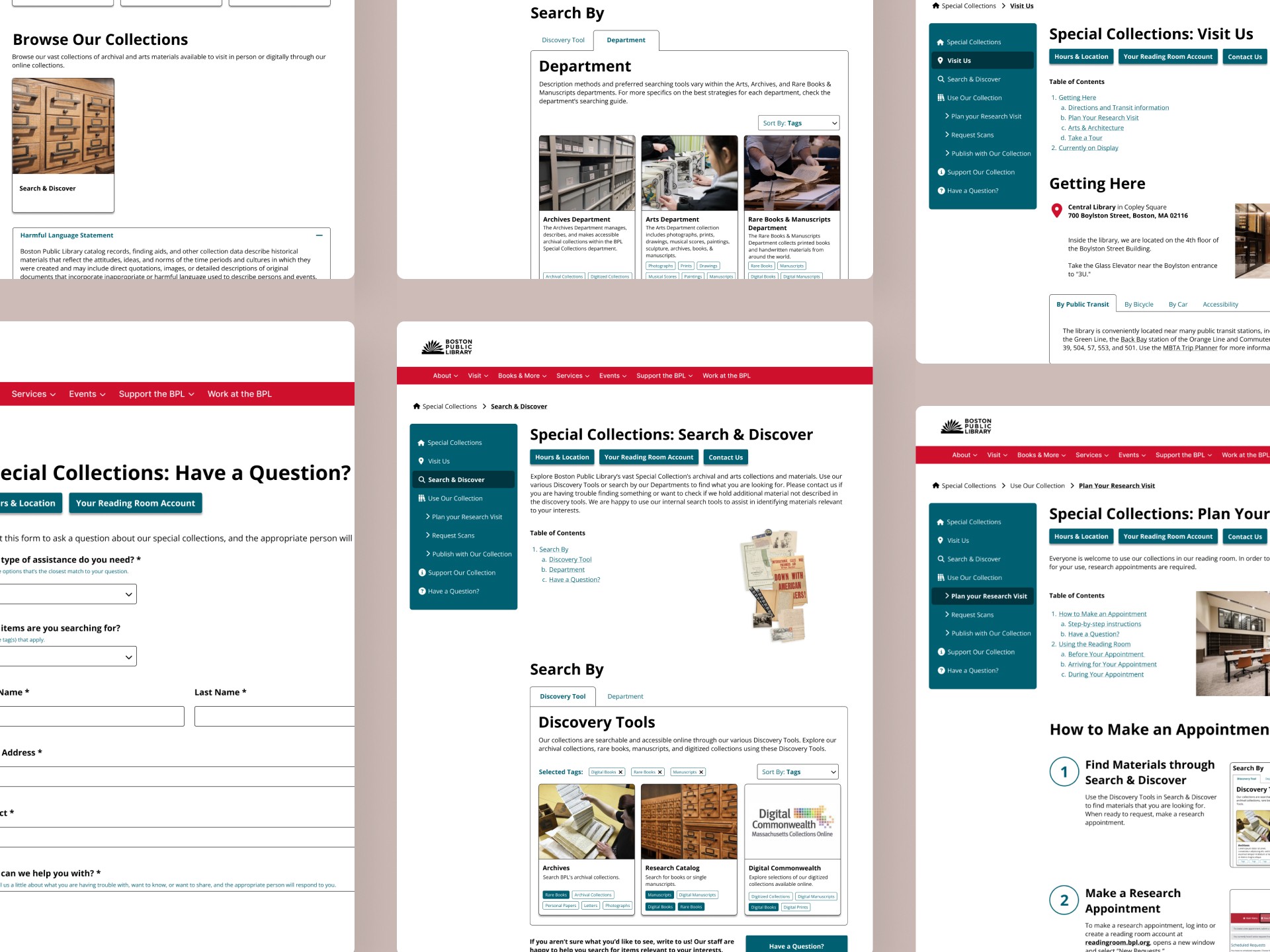
Each iteration focused on addressing the pain points and themes identified in our research. From sketching I jumped into low fidelity defining functionality and layout. I focused on reorganizing page hierarchy, introducing filter functionality, breadcrumbs, and other quick navigation, and redesigned workflows with annotated steps, clearer headers, and stronger visual hierarchy.

Moving into high fidelity I maintained consistency to BPL's current brand identity while refining the imagery, iconography, and content organization based on multiple rounds of usability testing ensuring clarity and discoverability.
The intent behind these design choices were to better explain what Special Collections is, help users identify the appropriate tools and materials, and help quickly orient the user on where they are.


Iteration
Each iteration focused on addressing the pain points and themes identified in our research. From sketching I jumped into low fidelity defining functionality and layout. I focused on reorganizing page hierarchy, introducing filter functionality, breadcrumbs, and other quick navigation, and redesigned workflows with annotated steps, clearer headers, and stronger visual hierarchy.
Moving into high fidelity I maintained consistency to BPL's current brand identity while refining the imagery, iconography, and content organization based on multiple rounds of usability testing ensuring clarity and discoverability.
The intent behind these design choices were to better explain what Special Collections is, help users identify the appropriate tools and materials, and help quickly orient the user on where they are.


Conclusion
The final experience significantly improved discoverability and task completion making navigation more intuitive, clarifying the purpose of each platform, and simplifying the request process. Recommendations were handed off the BPL Special Collections team and set to be implemented later that year.
Search & Discover Navigation Task Success
33% to 75%
Department Search Guide DiscoveryTask Success
44% to 100%
Appointment Workflow Completion
33% to 88%
Other Cases
Other Cases


